Dead on Arrival: The Organizational Patterns That Quietly Bury Strategic Initiatives Before They Mature

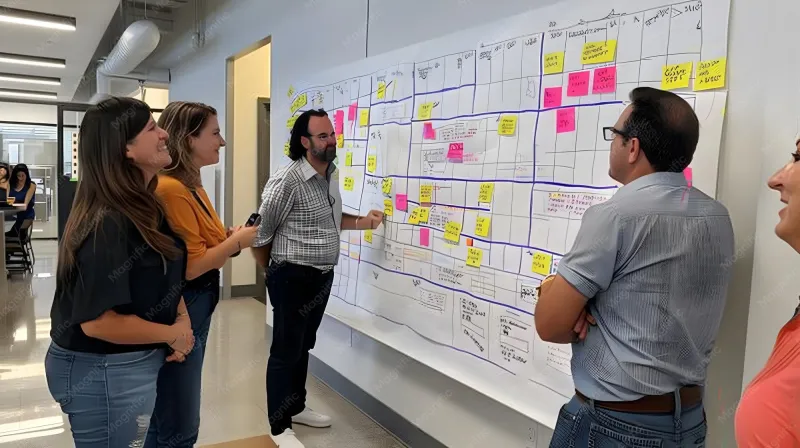
Photo: corporate strategy team reviewing initiative roadmap in boardroom, via img.freepik.com
Every year, American corporations collectively invest hundreds of billions of dollars in strategic initiatives — transformation programs, market expansion efforts, product innovation pipelines, operational redesigns. Leadership teams convene, consultants are engaged, slide decks are approved, and launch announcements go out. Then, with a quiet regularity that borders on institutional, the majority of those initiatives simply disappear.
Not with a dramatic failure. Not with a formal post-mortem or a transparent accounting of what went wrong. They simply drift off the agenda, crowded out by the next urgent priority, the next quarterly cycle, the next reorganization. According to research from the Project Management Institute and corroborated by multiple McKinsey surveys on strategic execution, roughly 73 percent of corporate initiatives fail to achieve their stated objectives within eighteen months of launch. A significant portion never reach the twelve-month mark at all.
Understanding why requires moving past the comfortable narrative that blames execution laziness or poor communication. The real culprits are more structural — and more correctable.
The Eighteen-Month Window: Why It Matters
Eighteen months is not an arbitrary benchmark. It represents the approximate span during which most organizations maintain active accountability for a new strategic initiative before competing priorities absorb available leadership attention. Beyond that window, initiatives that have not yet demonstrated measurable traction tend to lose their formal champions, their dedicated budget lines, and their position on executive dashboards.
This window is also where the gap between strategy formulation and strategy execution becomes most consequential. An initiative launched with strong boardroom momentum but insufficient operational infrastructure enters a kind of organizational limbo — visible enough to consume resources, but fragile enough to collapse under the first significant headwind.
For strategy leaders, the eighteen-month window is not a deadline to fear. It is a diagnostic frame. The question is not whether an initiative will face pressure during this period — it will. The question is whether the organizational conditions required to absorb that pressure have been deliberately constructed.
Decision-Making Failures That Accelerate Initiative Mortality
Three categories of decision-making failure account for the majority of premature initiative deaths.
The Sponsorship Vacuum. Most initiatives are launched with a named executive sponsor. Fewer are launched with a committed one. The distinction matters enormously. A sponsor who attaches their name to an initiative during the announcement phase but fails to actively defend resource allocation, remove organizational obstacles, and publicly reinforce progress during the difficult middle months is not a sponsor in any meaningful sense. Research by Harvard Business School's Amy Edmondson and others on organizational change consistently identifies the withdrawal of active senior sponsorship as one of the most reliable predictors of initiative failure. When the sponsor goes quiet, the organization interprets that silence as permission to deprioritize.
The Measurement Mismatch. Initiatives frequently fail not because they produce no results, but because the results they produce are invisible to the metrics the organization has chosen to track. A cultural transformation initiative measured exclusively against quarterly revenue figures will almost certainly appear to be failing during its first year — even if it is, in fact, building the conditions for durable long-term performance. When the measurement framework does not match the initiative's actual change theory, leadership loses confidence prematurely. The initiative gets quietly shelved not because it wasn't working, but because no one could see that it was.
The Resource Illusion. This is perhaps the most pervasive failure mode. An initiative is approved with a budget and a headcount allocation that looks adequate on paper but proves insufficient the moment it meets organizational reality. Teams are asked to run transformation programs as a secondary responsibility alongside their existing workloads. Technology investments are approved in principle but delayed in practice. When resources are nominally present but operationally unavailable, initiative leaders spend their energy managing scarcity rather than driving progress. Momentum erodes. Timelines slip. And eventually, the gap between original ambition and visible output becomes too wide for leadership to ignore.
The Warning Signs Most Organizations Miss
Early warning signs of initiative mortality are rarely dramatic. They tend to manifest as subtle shifts in organizational behavior that are easy to rationalize individually but alarming in aggregate.
Watch for the following:
-
Meeting frequency decline. When the cadence of initiative review meetings begins to stretch — from weekly to biweekly, from biweekly to monthly — it is rarely because the initiative has become self-sustaining. It is usually because leadership attention has migrated elsewhere.
-
Champion turnover. When the individuals most closely identified with an initiative leave, are reassigned, or are promoted into roles that remove them from day-to-day involvement, the initiative loses its institutional memory and its internal advocacy network simultaneously.
-
Language drift. Pay attention to how executives describe an initiative in public forums over time. When the confident, specific language of launch — "we will achieve X by Q3" — gives way to the vague, hedged language of managed retreat — "we continue to explore opportunities in this space" — the organization is preparing for a quiet exit.
-
Budget reclassification. When initiative-specific budget lines begin migrating into general operational accounts, it signals that the organization is no longer treating the effort as a distinct strategic priority.
A Diagnostic Framework for Reversing the Pattern
For strategy leaders who recognize these patterns in their current portfolio, the path forward begins with honest diagnosis rather than accelerated action.
Start by auditing your active initiative portfolio against three criteria: Does each initiative have an executive sponsor who has taken a visible, public accountability position in the last thirty days? Does each initiative have a measurement framework that captures leading indicators of progress — not just lagging financial outcomes? And does each initiative have dedicated resources that are operationally available, not merely budget-approved?
Initiatives that fail two or more of these criteria are at elevated mortality risk regardless of their strategic merit.
The next step is triage, not rescue. Not every at-risk initiative deserves the same intervention. Some warrant a formal reset — a structured recommitment that addresses sponsorship, measurement, and resourcing simultaneously. Others warrant an honest conversation about whether the strategic rationale that originally justified them remains valid. Organizational energy spent sustaining initiatives that no longer serve the strategy is organizational energy diverted from initiatives that do.
Finally, build the infrastructure for accountability before the next initiative launches. That means establishing a formal initiative governance process that tracks sponsorship activity, not just deliverable completion. It means designing measurement frameworks during the initiative design phase, not after launch. And it means treating resource adequacy as a launch criterion, not an assumption.
The Compounding Cost of Strategic Amnesia
There is a cost to initiative mortality that extends beyond the direct investment lost on any single effort. Organizations that repeatedly launch and abandon strategic initiatives develop a form of institutional cynicism — a learned skepticism among mid-level managers and frontline leaders about whether any new initiative will actually be sustained. That cynicism reduces engagement, slows adoption, and makes every subsequent initiative harder to execute, even when the strategy behind it is sound.
Reversing a 73 percent failure rate is not primarily a matter of choosing better strategies. It is a matter of building the organizational conditions in which good strategies can survive long enough to prove their worth.
The strategy graveyard fills up one quiet abandonment at a time. The organizations that keep it empty are the ones that treat execution infrastructure as a strategic asset — and invest in it accordingly.