If Your Team Can't Explain Your Strategy in Five Minutes, You Don't Have One

Photo: executive team whiteboard strategy meeting corporate clarity, via thumbs.dreamstime.com
There is a revealing exercise that exposes one of corporate America's most expensive blind spots. Ask five people at different levels of your organization — a C-suite executive, a regional manager, a frontline sales representative, a product developer, and a customer service associate — to describe your company's competitive advantage. Do it separately, without preparation, in plain English.
In most organizations, the answers will bear almost no resemblance to one another.
This is not a communication problem. It is a strategy problem. And it is far more prevalent than most leadership teams are willing to acknowledge. Research consistently suggests that fewer than three in ten employees can accurately describe their organization's strategy, and a striking number of senior executives struggle to articulate a differentiated competitive position without retreating to vague language about "quality," "innovation," or "customer focus" — phrases that describe aspiration, not advantage.
The consequence is not merely an internal alignment issue. Strategies that cannot be articulated cannot be executed. And strategies that cannot be executed are not strategies at all — they are intentions dressed in the language of planning.
The Illusion of Strategic Clarity
The process by which organizations arrive at this state is rarely dramatic. It typically unfolds gradually, through a series of reasonable-sounding decisions made during strategy development.
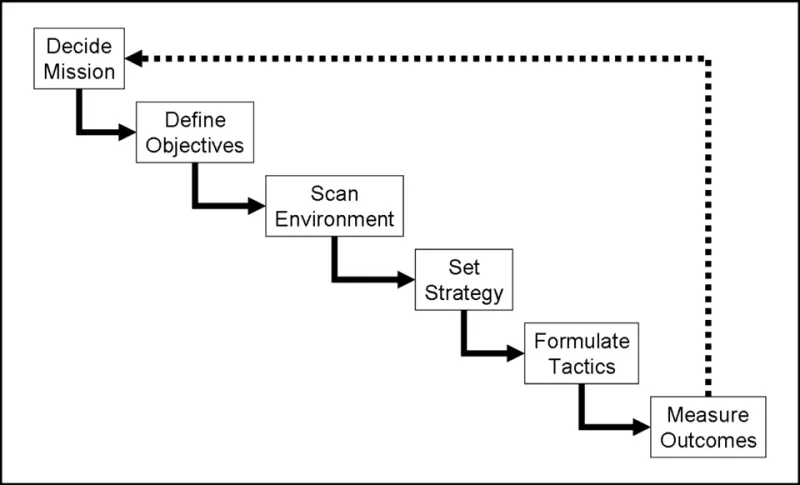
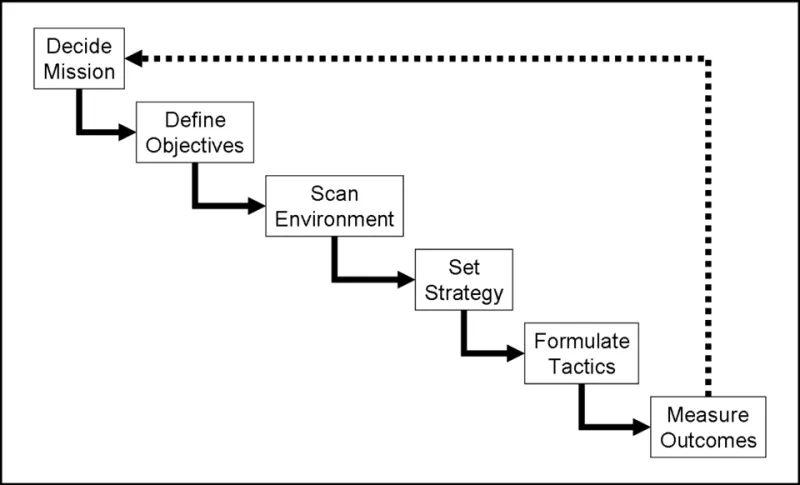
A leadership team convenes an offsite. Consultants are engaged. Market analyses are commissioned, competitive landscapes are mapped, and customer surveys are aggregated. After several months and considerable expense, a strategy document emerges — polished, comprehensive, and internally consistent. It is presented to the board. It is approved. It is distributed.
And then, in most organizations, it quietly disappears into operational complexity.
The document exists. The strategy, in any functional sense, does not.
What tends to survive is a collection of strategic themes — broad directional statements that feel meaningful in a conference room but offer little practical guidance when a sales team is deciding which accounts to prioritize, or when a product manager is choosing between two competing feature investments. These themes are not wrong, exactly. They are simply insufficient. They describe the direction of travel without mapping the road.
The result is what might be called strategic diffusion: the gradual dispersal of organizational energy across initiatives that are individually defensible but collectively incoherent.
Why Vagueness Is More Dangerous Than a Bad Strategy
Conventional wisdom holds that a flawed strategy, once recognized, can be corrected. This is true. What is considerably harder to correct is a strategy whose flaws are invisible because its language is abstract enough to accommodate almost any interpretation.
Vague strategies are particularly dangerous for three reasons.
First, they create the illusion of alignment. When strategic language is general enough — "deliver exceptional value," "lead through innovation," "build lasting customer relationships" — almost any activity can be framed as consistent with it. This produces false consensus. Teams believe they are aligned because they all agree with the words, not recognizing that they hold fundamentally different understandings of what those words mean in practice.
Second, vague strategies are immune to accountability. It is difficult to measure progress against an objective that has no clear definition. When results disappoint, the strategy is rarely examined because no one can point to a specific strategic commitment that was not honored. The conversation shifts to execution, culture, or market conditions — anywhere but the strategy itself.
Third, and perhaps most consequentially, vague strategies fail to guide trade-offs. Strategy, at its core, is a system of prioritized choices. It answers the question of what the organization will do and, equally importantly, what it will not do. When strategy is abstract, the discipline of saying no — to markets, to products, to customer segments — dissolves. Organizations pursue everything moderately instead of something decisively, and competitive advantage never materializes.
The Five-Minute Elevator Test
One of the most practical diagnostics available to leadership teams is deceptively simple: can your strategy survive a five-minute elevator pitch from someone who did not help create it?
The test has three components.
Specificity. Can the person describe not just what the organization does, but why customers choose it over alternatives? Generic claims about quality or service do not qualify. The answer must identify a specific, defensible source of differentiation — something the organization does demonstrably better, faster, or differently than competitors in ways that matter to a defined customer.
Exclusivity. Could the same description apply to a significant competitor? If so, it is not a competitive advantage — it is a category description. Genuine competitive advantage is, by definition, not shared. The strategy must identify what makes the organization's position difficult to replicate, not merely what makes it competent.
Actionability. Does the description provide enough direction to guide a real decision? If a manager facing a resource allocation choice could use the strategy to determine the right answer, it is functional. If the strategy is compatible with almost any answer, it is decorative.
Organizations that fail this test — and many will — should resist the temptation to address the symptom by improving communications. The problem is upstream. It lives in the strategy itself.
Rebuilding Strategic Clarity From the Inside Out
Recovering strategic clarity requires a willingness to question documents that may have consumed significant time and resources to produce. That is uncomfortable. It is also necessary.
The most effective approach begins not with rewriting strategy documents but with structured conversation. Gather cross-functional input on three foundational questions: Who, specifically, are we choosing to serve? What, specifically, do we offer them that they cannot get as effectively elsewhere? And how, specifically, does our operating model sustain that advantage over time?
The answers to these questions — not the language of strategy documents, but the actual answers that emerge from honest organizational dialogue — reveal whether a coherent strategy exists beneath the terminology. Frequently, the exercise surfaces meaningful disagreement among senior leaders about all three. That disagreement is not a failure of the exercise. It is the exercise working as intended, surfacing misalignment that was always present but previously hidden behind shared vocabulary.
Once genuine alignment exists on these foundational questions, the work of translating that alignment into language that travels across the organization can begin. The goal is not simplification for its own sake. It is precision — strategy language that is clear enough to guide decisions made by people who were not in the room when the strategy was created.
The Competitive Cost of Internal Confusion
Organizations that cannot articulate their competitive advantage do not merely struggle internally. They signal that confusion to the market.
Customers experience it as inconsistency — in messaging, in product decisions, in service priorities. Prospective employees encounter it during recruiting and become skeptical. Partners and investors notice the absence of a coherent narrative and discount accordingly.
The companies that sustain competitive advantage over time share a common characteristic that is easy to observe and difficult to manufacture: clarity. They know what they are building, they know who they are building it for, and they can explain both without hesitation.
That clarity is not accidental. It is the product of rigorous strategic thinking — the kind that prioritizes precision over comprehensiveness, and honest trade-offs over aspirational language.
The strategy graveyard is full of documents that described the future without enabling it. The organizations that grow are the ones that treat strategic clarity not as a communication objective, but as a competitive discipline.
Start with the elevator test. The results may be more instructive than any market analysis your organization has commissioned.