When Strategy Dies Between the Boardroom and the Floor: Diagnosing Execution Failure Before It Costs You Growth
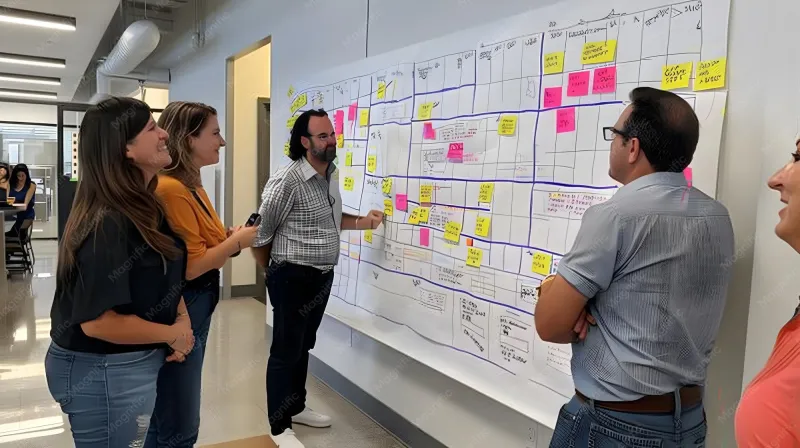
Photo: business team strategy meeting whiteboard planning corporate office, via img.freepik.com
Every quarter, leadership teams across the United States invest significant time and capital crafting strategic plans. Consultants are engaged, offsites are scheduled, frameworks are debated, and polished decks emerge from the process. Then, six months later, the numbers tell a different story. Revenue targets are missed. Initiatives stall. Teams operate in silos. And the plan that looked so compelling on paper sits quietly in a shared drive, largely untouched.
This is not a strategy problem. It is an execution problem—and it is far more common than most executives are willing to admit.
At StratFu, we have observed this pattern repeatedly across industries: the gap between strategy formulation and strategy execution is not a minor implementation hiccup. It is a structural failure with identifiable causes and, critically, correctable solutions.
The Illusion of Alignment
One of the most persistent myths in corporate planning is that leadership consensus equals organizational alignment. A room full of executives nodding at a strategic priority does not mean the 200 people responsible for executing it share the same understanding—or the same motivation.
Research consistently shows that a significant majority of frontline employees cannot accurately describe their company's top strategic priorities. This is not a communication failure in the traditional sense. It is a translation failure. Strategy is often articulated in language that is meaningful at the executive level but abstract to the teams expected to operationalize it. Phrases like "drive customer-centric innovation" or "optimize for scalable growth" provide insufficient guidance when a product manager needs to decide which feature to prioritize on a Tuesday morning.
The fix begins with specificity. Every strategic priority should be translatable into a concrete decision at every level of the organization. If it cannot be, the framework has not been fully developed—it has only been partially built.
Misaligned Incentives: The Hidden Saboteur
Perhaps the most insidious cause of execution failure is the incentive structure that quietly undermines stated strategic goals. Organizations frequently articulate one set of priorities while rewarding behavior that contradicts them.
Consider a company that declares market expansion into new verticals as a top strategic initiative, yet continues to compensate its sales force primarily on renewals within existing accounts. The incentive structure communicates the real priority far more loudly than any strategic document. Rational employees follow the money, not the memo.
Effective execution requires that compensation structures, performance reviews, resource allocation, and recognition systems all point in the same direction as the stated strategy. When they diverge, the strategy loses—every time.
Leadership teams should conduct a straightforward audit: for each major strategic initiative, identify every formal and informal incentive that touches the teams responsible for delivery. Where misalignment exists, it must be corrected before the initiative launches, not after it stalls.
The Ownership Vacuum
Strategy documents frequently identify what needs to happen without clearly designating who is accountable for making it happen. Shared ownership, in practice, often means no ownership. When multiple departments are listed as stakeholders on a strategic initiative, accountability diffuses to the point of invisibility.
High-performing organizations assign a single named owner to each strategic priority—an individual with the authority, resources, and accountability to drive outcomes. This person is not a committee. They are not a cross-functional task force. They are one leader who will answer for the result.
This approach requires organizational courage. It means resisting the political impulse to distribute credit broadly and instead accepting the operational necessity of clear accountability. The discomfort of that clarity is far preferable to the cost of another missed initiative.
Communication That Actually Reaches the Field
Most organizations communicate strategy downward through a cascade model: executive presentations flow to senior managers, who brief their teams, who theoretically pass the message along. In practice, this cascade degrades rapidly. By the time strategic intent reaches the people doing the work, it has often been filtered, reinterpreted, or simply lost.
Leading companies are replacing the cascade with a rhythm of direct, repeated communication from senior leaders—not just at the annual all-hands meeting, but on a consistent cadence throughout the year. The goal is not to repeat the same slide deck. It is to connect daily work to strategic purpose in language that resonates with each audience.
Digital communication tools have made this more achievable than ever, but technology is not the solution on its own. The quality of the message matters as much as the frequency of delivery.
A Diagnostic Checklist for Leadership Teams
Before your next planning cycle concludes, use the following diagnostic to assess your organization's execution readiness:
Clarity
- Can every team member articulate the top three strategic priorities in plain language?
- Has each priority been translated into specific decisions and behaviors at every organizational level?
Accountability
- Does each strategic initiative have a single named owner with explicit authority and resources?
- Are ownership expectations documented and visible across the organization?
Incentive Alignment
- Do compensation, performance metrics, and recognition systems reinforce the stated strategy?
- Have you identified and addressed any structural misalignments before launch?
Communication Cadence
- Is strategic progress reviewed and communicated on a regular schedule—not just at annual reviews?
- Are senior leaders consistently connecting operational work to strategic purpose?
Resource Commitment
- Have sufficient budget and headcount been allocated to each priority, or are teams expected to execute on top of existing workloads?
- Are resource allocation decisions being made in alignment with stated priorities?
Closing the Gap
Execution failure is rarely the result of bad strategy. More often, it is the product of structural conditions that make successful implementation nearly impossible before the first action is taken. Misaligned incentives, diffuse accountability, degraded communication, and under-resourced initiatives are not inevitable features of organizational life. They are solvable problems—provided leadership teams are willing to examine them honestly.
The most effective strategic frameworks are not the most sophisticated ones. They are the ones that travel intact from the conference room to the field, that translate cleanly into daily decisions, and that are supported by organizational systems designed to reinforce rather than undermine their intent.
At StratFu, our position is straightforward: strategy without execution architecture is incomplete. Building the framework is only half the work. The other half is building the conditions under which that framework can actually function.
The diagnostic process outlined here is a starting point. The more important step is the willingness to act on what it reveals.