The Annual Strategy Cycle Is Broken: Why America's Fastest-Growing Companies Have Moved On

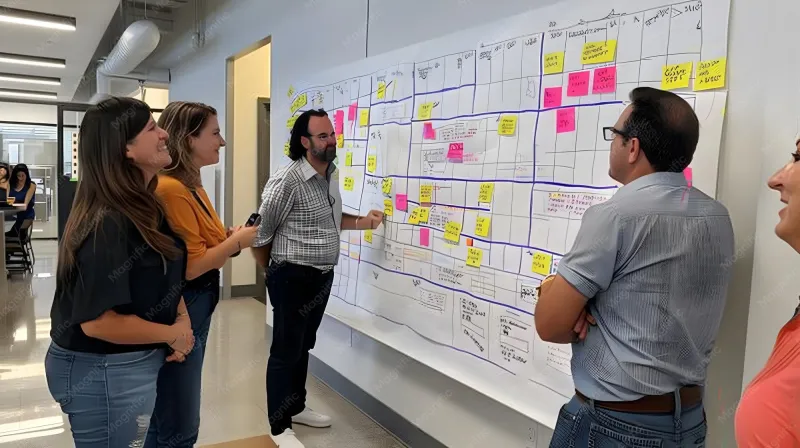
Photo: agile business strategy team collaboration growth charts modern office, via thumbs.dreamstime.com
There is something almost ceremonial about the annual strategic planning process. The calendar turns. Executives retreat. Market analyses are commissioned. Objectives are debated and refined. A plan emerges, is ratified, and is rolled out to the organization with appropriate fanfare. Then the world changes—because it always does—and the plan begins its quiet obsolescence.
For most of the twentieth century, this ritual made reasonable sense. Markets moved at a pace that allowed organizations to plan on annual horizons and still respond with adequate speed. That era is over. And yet, a surprising number of US companies continue to operate as though it is not.
The argument here is direct: the annual strategic planning cycle, as traditionally practiced, is no longer a competitive asset. For many organizations, it has become a competitive liability. The companies recognizing this earliest—and acting on it—are pulling ahead at a rate that their slower-adapting peers are struggling to explain.
What the Annual Cycle Was Built For
To understand why the traditional model is failing, it helps to understand what it was designed to do. Annual strategic planning emerged in an environment where competitive landscapes shifted gradually, capital allocation decisions had long lead times, and information about market conditions was expensive and slow to gather.
In that context, investing significant organizational energy once a year to set direction made operational sense. The plan could reasonably be expected to remain relevant for the duration of the planning horizon. Quarterly reviews served as checkpoints, not course corrections.
None of those conditions hold today. Consumer behavior can shift meaningfully in a matter of weeks. Competitive threats now emerge from adjacent industries and international markets simultaneously. Technological disruption compresses product cycles. The information required to make strategic decisions is abundant, real-time, and often overwhelming. Planning annually in this environment is not disciplined—it is slow.
How Adaptive Frameworks Actually Work
The alternative is not the absence of strategy. That is a common and consequential misunderstanding. Adaptive frameworks do not abandon long-term direction—they separate it from the mechanisms used to pursue it.
The model that high-growth companies are increasingly adopting operates on two distinct layers. The first is a durable strategic intent: a clear articulation of where the organization is going, what it stands for, and what capabilities it is building. This layer changes infrequently and provides the stability that large organizations require to function cohesively.
The second layer is tactical and fluid. It encompasses the specific initiatives, resource allocations, and market bets that the organization is making right now to advance toward that intent. This layer is reviewed and adjusted on a continuous basis—monthly, sometimes weekly—in response to incoming data.
The distinction matters enormously. Companies that conflate strategic intent with tactical execution find themselves either paralyzed by constant repositioning or rigidly committed to initiatives that the market has already rendered irrelevant. Separating the two layers allows organizations to be both anchored and agile.
The Companies Leading the Shift
The transition away from annual planning is most visible among technology-adjacent firms, but it is spreading well beyond Silicon Valley. Retail, healthcare, financial services, and logistics companies across the United States are experimenting with continuous strategy models, and the results are instructive.
Spotify's well-documented "Squad" model, while primarily associated with product development, reflects a broader commitment to operating in short, iterative cycles with clearly defined ownership and rapid feedback loops. The company's ability to respond to shifts in music consumption behavior and competitive pressure from platforms like Apple Music and Amazon Music has been enabled in part by this structural agility.
HubSpot has similarly built its planning cadence around shorter cycles, with product and go-to-market teams operating on quarterly sprints tied to a longer-range strategic narrative. The company's consistent revenue growth—even as the competitive landscape for CRM and marketing software has intensified—reflects the compounding advantage of faster organizational learning.
Outside the technology sector, retailers like Warby Parker have demonstrated how continuous strategic adaptation, informed by real-time customer data and rapid test-and-learn cycles, can enable a challenger brand to compete effectively against established incumbents with far greater resources.
The common thread is not a specific framework or methodology. It is an organizational commitment to treating strategy as a living discipline rather than an annual event.
The Objections—and Why They Do Not Hold
The resistance to abandoning annual planning cycles is understandable and, in some cases, legitimate. Large public companies face reporting obligations that create real pressure to operate on calendar-year rhythms. Organizations with complex supply chains or long capital allocation cycles cannot pivot as freely as a software startup.
These constraints are real, but they do not require organizations to plan only annually. They require that certain decisions—capital expenditure, workforce planning, investor guidance—be made on structured timelines. The strategic thinking that informs those decisions can and should happen continuously.
Another common objection is that continuous planning creates organizational fatigue and strategic confusion. This is a genuine risk, but it is a risk of poor implementation, not of the model itself. Adaptive frameworks require discipline—clear decision rights, explicit review cadences, and strong communication infrastructure. Without those elements, any planning model will produce noise rather than clarity.
Building the Capability to Adapt
Shifting to an adaptive strategy model is not a software purchase or a process redesign. It is a capability-building exercise that touches organizational culture, leadership behavior, and decision-making infrastructure.
Leadership teams serious about making this transition should consider three foundational investments. First, develop a robust strategic intelligence function—a systematic approach to gathering, synthesizing, and distributing market signals across the organization. The quality of adaptive decisions is only as good as the quality of the information driving them.
Second, establish explicit decision rhythms. Adaptive does not mean ad hoc. Define when strategic reviews happen, who participates, what decisions are on the table, and how outcomes are communicated. Structure enables speed rather than constraining it.
Third, build tolerance for iteration at the leadership level. In many US corporate cultures, changing course is still perceived as a sign of weakness or poor planning. Reframing strategic iteration as organizational learning—and modeling that reframe from the top—is essential to making adaptive frameworks function in practice.
The Competitive Clock Is Running
The companies that are thriving in the current environment share a willingness to treat their strategies as hypotheses to be tested rather than plans to be executed. They invest in the infrastructure to learn quickly, the culture to act on what they learn, and the discipline to distinguish meaningful signals from market noise.
The annual planning cycle will not disappear overnight. But its role is changing. For organizations willing to evolve ahead of the curve, the shift toward adaptive frameworks represents one of the most consequential strategic moves available today—not because it is novel, but because it is increasingly necessary.