Momentum Lost: Diagnosing the Inflection Points Where Corporate Strategy Quietly Collapses

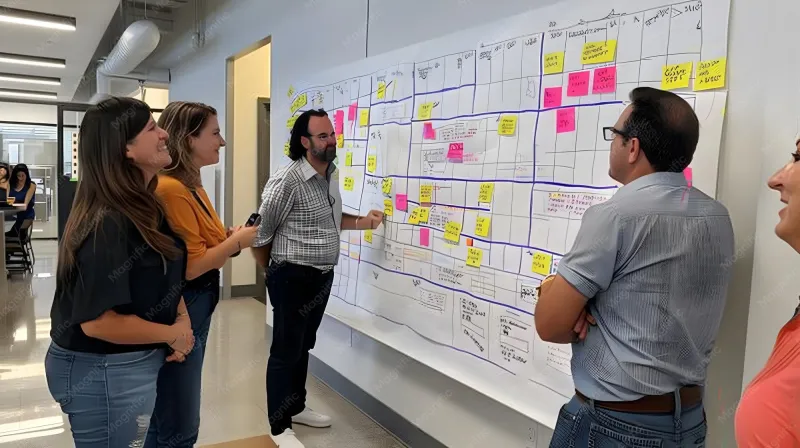
Photo: Barry Bahler, Public domain, via Wikimedia Commons
The Graveyard No One Audits
Every January, conference rooms across America fill with ambitious thinking. Whiteboards accumulate frameworks, consultants present data, and leadership teams align — at least nominally — around a coherent direction. By September, the same organizations are quietly managing around the plan rather than through it. Priorities have shifted. Resources have been reallocated. The original strategic narrative has been replaced by an unspoken consensus that the goals were unrealistic, the timing was off, or the market simply didn't cooperate.
What rarely gets examined is the precise moment the plan stopped functioning as a guide and started functioning as a liability. That diagnostic gap is expensive. When organizations fail to identify where strategy collapses, they repeat the same collapse the following year — often with more sophisticated language and identical results.
Research from across the strategy and organizational behavior disciplines converges on a troubling figure: somewhere between 67 and 80 percent of strategic plans are functionally abandoned before the fiscal year concludes. The most commonly cited marker is Q3. By that point, the energy of annual planning has dissipated, mid-year budget reviews have redistributed resources toward short-term performance, and the connective tissue between strategic intent and daily operations has deteriorated past the point of informal repair.
Three Inflection Points That Determine Strategic Survival
Abandonment is rarely a single event. It is a sequence of small surrenders, each one rationalized in isolation and catastrophic in aggregate. Across organizations that have experienced plan failure, three inflection points appear with notable consistency.
The First Inflection: The 90-Day Accountability Vacuum
The period immediately following strategic plan ratification is paradoxically the most dangerous. Leadership attention is high, communication is strong, and the plan feels real. But the operational machinery — the specific ownership assignments, milestone cadences, and resource commitments that translate strategy into action — is rarely in place before attention moves to execution. When the first quarterly review arrives without a functioning accountability structure, the plan's authority begins to erode. Teams default to pre-existing workflows. Strategic initiatives compete unsuccessfully with operational urgencies. The plan survives on paper; in practice, it has already been superseded.
High-growth companies address this by treating the 30 days following plan ratification as a distinct implementation phase, not a natural extension of planning. Strategic owners are assigned with explicit accountability — not advisory roles — and milestone structures are built before the plan is formally launched.
The Second Inflection: The Mid-Year Budget Recalibration
For most US corporations, the mid-year financial review is where strategy meets fiscal reality. In organizations with healthy execution cultures, this is a productive tension. In organizations with fragile strategic alignment, it is where plans are quietly dismantled. Resources originally committed to strategic initiatives get redeployed toward quarterly performance gaps. The language used is invariably pragmatic — "we need to protect the core," "market conditions have shifted" — but the effect is structural. Once funding is redirected away from a strategic initiative, the organizational signal is clear: this is not actually a priority.
The correction here is not to insulate strategy from financial discipline, but to build a formal protocol for strategic trade-off decisions. When resources must be reallocated, the decision should be explicit, documented, and evaluated against long-term cost — not handled as a quiet budget adjustment.
The Third Inflection: The Q3 Confidence Collapse
By the third quarter, organizations that have survived the first two inflection points face a subtler threat: the erosion of belief. Teams that have been executing against strategic goals for six months without visible progress begin to question whether the effort is worth sustaining. Leadership, under pressure to demonstrate results, shifts its communication toward near-term wins rather than strategic milestones. The plan begins to feel like an artifact of a more optimistic moment.
This is the inflection point most commonly misidentified as execution failure. In reality, it is a motivation and narrative failure. The strategic story has not been maintained. Progress — even incremental progress — has not been made visible. The human systems that sustain long-cycle work have not been adequately supported.
Why 'Execution Failure' Is an Incomplete Diagnosis
The default explanation for abandoned strategy is execution failure: the organization could not translate good ideas into operational reality. This framing is not wrong, but it is incomplete in ways that matter.
Execution failure is a symptom. The underlying conditions that produce it are more specific and more addressable. They include misaligned incentive structures that reward short-term performance metrics over strategic milestones, insufficient investment in the middle-management layer that actually drives cross-functional coordination, and the absence of a formal strategic review cadence that is distinct from — and protected from — operational performance reviews.
Perhaps most importantly, abandoned strategy frequently reflects a planning process that generated consensus on goals without generating genuine commitment to trade-offs. When every priority is a priority, none are. Organizations that articulate strategic direction without explicitly identifying what they will stop doing, spend less on, or deprioritize create conditions where strategy and operations compete rather than align.
Recovery Mechanisms Before Initiatives Become Sunk Costs
For organizations that recognize themselves in the patterns above, the window for recovery is narrower than most assume — but it is real. The companies that successfully resurrect stalled strategic initiatives share several practices worth examining.
First, they conduct a formal momentum audit rather than a performance review. The distinction matters. A performance review asks whether targets were hit. A momentum audit asks why forward motion stopped, where accountability broke down, and what minimum viable intervention could restore trajectory. The former generates defensiveness; the latter generates actionable intelligence.
Second, they practice strategic triage. Not every initiative that has stalled deserves resurrection. Organizations that try to revive everything revive nothing. The discipline of formally classifying initiatives as viable, conditionally viable, or retired — and communicating those classifications clearly — preserves organizational credibility and concentrates recovery energy where it can produce results.
Third, they rebuild the strategic narrative from current conditions rather than original assumptions. One of the most common recovery failures is attempting to re-energize a plan by restating the original rationale. If that rationale were compelling enough to sustain momentum, momentum would not have stalled. Effective recovery reanchors the strategic case in present circumstances, demonstrating that the direction remains sound even if the path has required adjustment.
The Cost of Leaving the Graveyard Unexamined
Organizations that treat strategic abandonment as an unremarkable feature of business life — an expected gap between aspiration and reality — pay a compounding price. Each failed cycle deposits residual cynicism into the organizational culture. Teams become less willing to invest genuine effort in the next planning cycle because experience has taught them that the investment will not be honored. Leadership loses credibility as a steward of direction. The planning process itself becomes theatrical rather than functional.
The 73 percent figure is not a benchmark to accept. It is a diagnostic starting point. The organizations that consistently outperform their peers over multi-year horizons are not those that plan better in January — they are those that have built the structural and cultural capacity to sustain strategic momentum through the specific inflection points where most organizations quietly surrender.
That capacity is neither accidental nor innate. It is designed, tested, and refined. The graveyard is optional.